What is cold laser therapy?
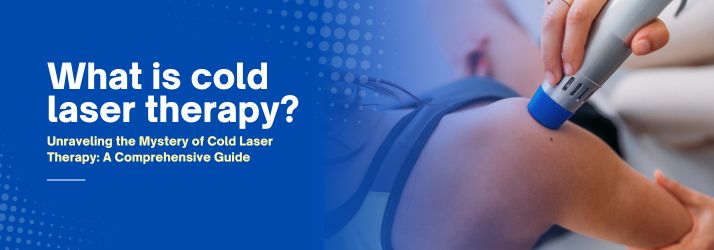
Cold laser therapy is a common name for low-level laser therapy: light applied to tissue as a treatment, without a surgical incision. It is also discussed under the term photobiomodulation. The device and dose matter, so evidence about one treatment should not be assumed to describe every laser or red-light product.
Does research show a benefit?
The evidence depends on the condition and treatment studied. For chronic low-back pain, NCCIH describes some favorable results but notes limited research and low-quality evidence underlying a guideline recommendation. That is a reason to ask about the specific evidence, rather than expect a guaranteed response. NCCIH: low-back pain and complementary approaches.
Descriptions of light acting on cells are proposed explanations, not proof that a treatment will help a particular person. A useful discussion starts with the diagnosis, realistic goals, alternatives and a point at which to reassess.
How does this relate to the laser used here?
Source Chiropractic uses the Summus Horizon, a Class IV medical laser. Class IV describes a laser hazard, rather than the condition treated or the likelihood of improvement. Our laser and LED light therapy page describes the practice's device and use.
Summus describes its intended use as local heating for temporary comfort in minor muscle or joint complaints, along with temporary local circulation and relaxation effects. That is narrower than claims of tissue repair or disease reversal. Read the manufacturer's Horizon information.
We do not use laser to treat diabetic neuropathy, wounds or burns, trigeminal neuralgia or cosmetic skin concerns.
What about safety and alternatives?
Non-invasive does not mean risk-free. Class IV beams can injure eyes or skin, including through reflected exposure. Ask about protective eyewear, operator training and precautions specific to you. FDA: laser hazards.
For low-back pain, exercise and appropriate activity have a place in care, and manual therapy is considered within an exercise-based plan. A clinician can discuss medical management or physical therapy when appropriate. NICE: low-back pain recommendations.
Questions to take to an appointment
Ask which device is proposed, what evidence supports its use for your problem, what improvement would justify continuing, and what each visit costs. Also ask what happens if symptoms worsen or treatment does not help.
Contact the practice for service details and read the new-patient offer terms before booking. The laser research notes explain what selected trials found and what they cannot establish about a particular device or treatment plan.
Follow the evidence
Research, with context.
Published sources behind the discussion. Read the findings alongside the limits; a study is not a diagnosis or a promise of a result.
Photobiomodulation therapy is not better than placebo in patients with chronic nonspecific low back pain: a randomised placebo-controlled trial
148 adults with chronic nonspecific low-back pain, receiving 12 active or placebo sessions over four weeks; both groups received education.
What it foundThere was no clinically important difference in the primary pain and disability outcomes at four weeks.
What it cannot tell usPatients, therapists and assessors were blinded. The trial tests one protocol; it does not show that all laser devices are equivalent or support claims that light regenerates a disc.
Publication details & citation
Guimarães et al. Photobiomodulation therapy is not better than placebo in patients with chronic nonspecific low back pain: a randomised placebo-controlled trial. Pain. 2021. DOI: 10.1097/j.pain.0000000000002189.
Read the publication recordThe effects of photobiomodulation and transcutaneous electrical nerve stimulation on chronic neck pain: A double-blind, randomized, sham-controlled trial
144 people with chronic neck pain, assigned photobiomodulation, electrical stimulation, both, or sham treatment for ten sessions over two weeks.
What it foundThe groups did not differ in the primary outcome of pain at rest. Some secondary outcomes favored the combined treatment.
What it cannot tell usSecondary findings from a combined intervention cannot establish the effect of light therapy alone. The treatment period was short.
Publication details & citation
Rampazo et al. The effects of photobiomodulation and transcutaneous electrical nerve stimulation on chronic neck pain: A double-blind, randomized, sham-controlled trial. Brazilian Journal of Physical Therapy. 2024. DOI: 10.1016/j.bjpt.2024.101124.
Read the publication record
Read our editorial policy for how sources and clinical review are identified.